Why European Nail Training Standards Feel Different (And Why It Matters for Your Results)
Quick Answer: What Makes European Nail Training Standards Different?
European nail training standards emphasise precision cuticle work, clean application without skin contact, structural understanding of apex placement and stress zones, continuous explanation of technique reasoning, and a culture of ongoing professional upskilling through regular masterclasses.
These differences in training depth, precision focus, and professional expectations directly affect long-term nail retention, client satisfaction, and your ability to troubleshoot problems confidently.
How Training in Bulgaria Shaped My Approach to Nail Education
I originally trained in Bulgaria, where nail education is extremely detailed, structured, and technique-focused. Every lesson included continuous explanation of why each step mattered, precise anatomical terminology, and a strong emphasis on achieving clean, professional results that would last.
When I later moved to the United Kingdom, I noticed a clear difference in how nail services were performed and how technicians were trained. It was not about right or wrong — it was about depth, precision, and expectations.
The difference became particularly visible when I observed how cuticle work was approached, how product application was taught, and how structural understanding was either emphasised or skipped entirely in training content available to students.
This is also why I continue to invest in masterclasses and advanced training across Europe, constantly updating my methods, learning new techniques, and refining my standards. The culture of continuous professional development in Eastern Europe means that nail education does not stop after your initial qualification — it continues throughout your career.
The Real Differences in Training Standards
Different training standards produce different results. Understanding these differences helps you recognise what to look for when choosing professional nail education and what to expect from your own technique development.
These differences are not about nationality or location. They are about the educational approach, the depth of explanation, and the professional standards considered acceptable within different training systems.
1. Precision vs Basic Application
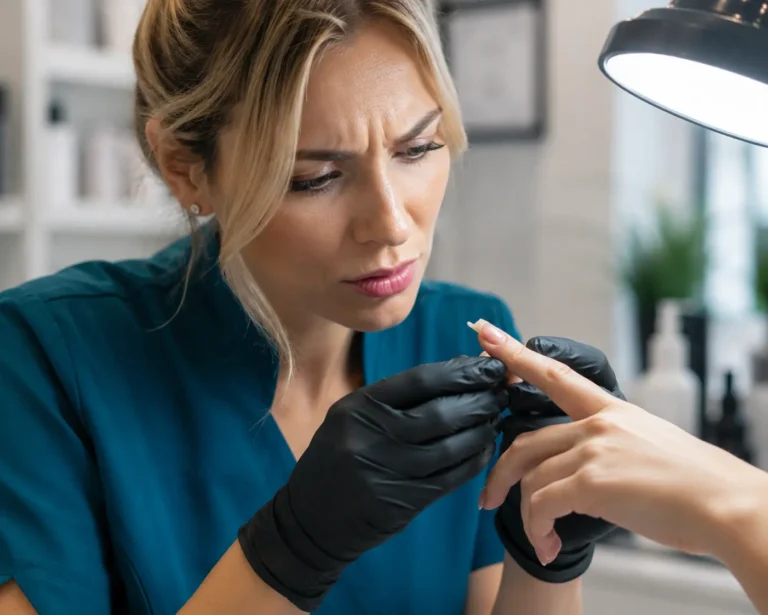
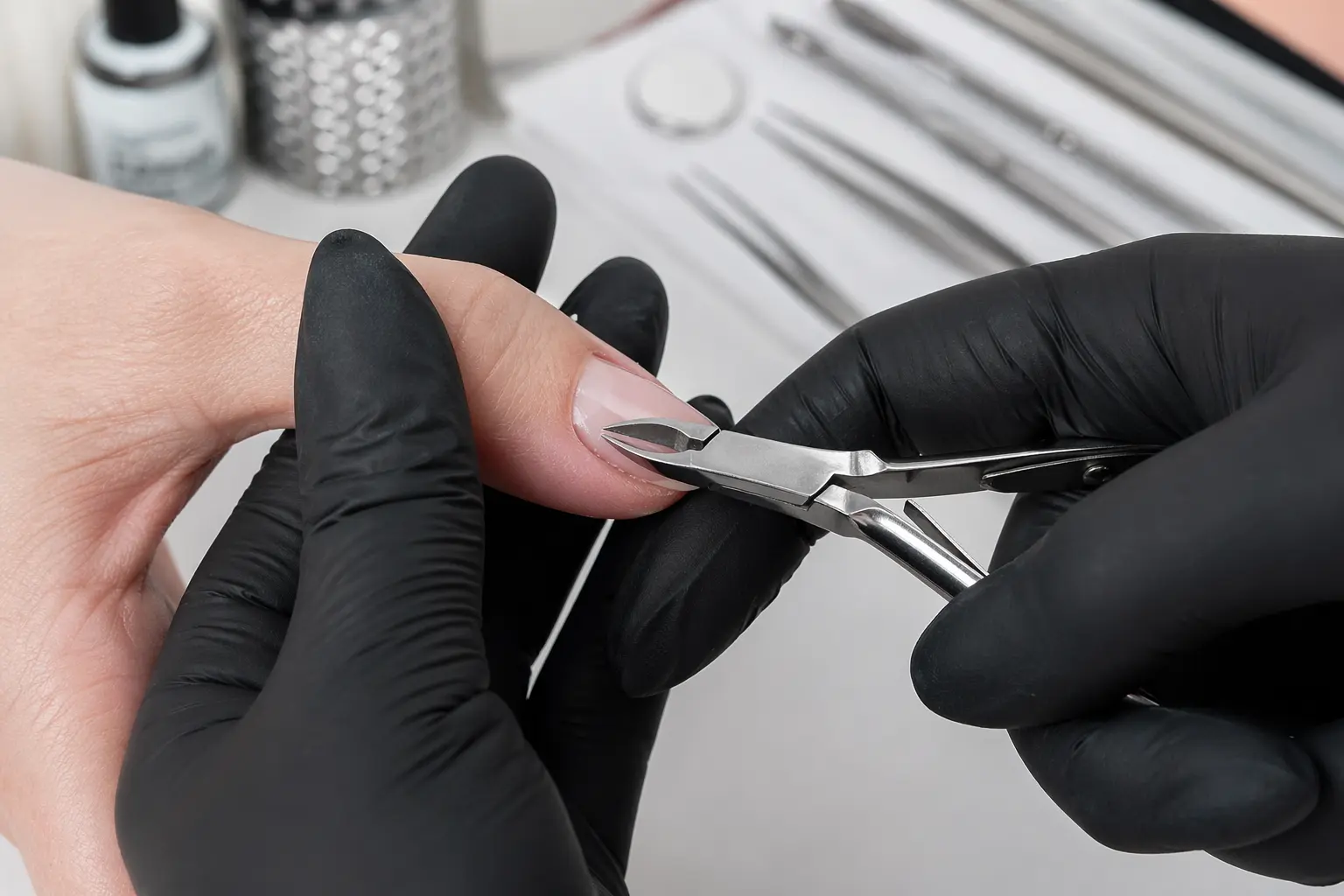
European nail training focuses heavily on achieving precision at every stage of the service. This includes cuticle perfection — removing true cuticle cleanly from the nail plate without damaging surrounding tissue, whilst the eponychium is carefully cut and removed using proper technique.
Clean application without touching skin is another core principle. You learn to control product placement so gel, builder gel, or polygel sits only on the nail plate, never flooding the proximal nail fold, hyponychium, or sidewall skin. This precision reduces sensitisation risk and improves adhesion.
Structural balance is taught from the beginning. You understand why apex placement matters for different nail shapes, where stress zones occur, and how to distribute product volume to create enhancements that withstand normal hand movement without cracking or lifting.
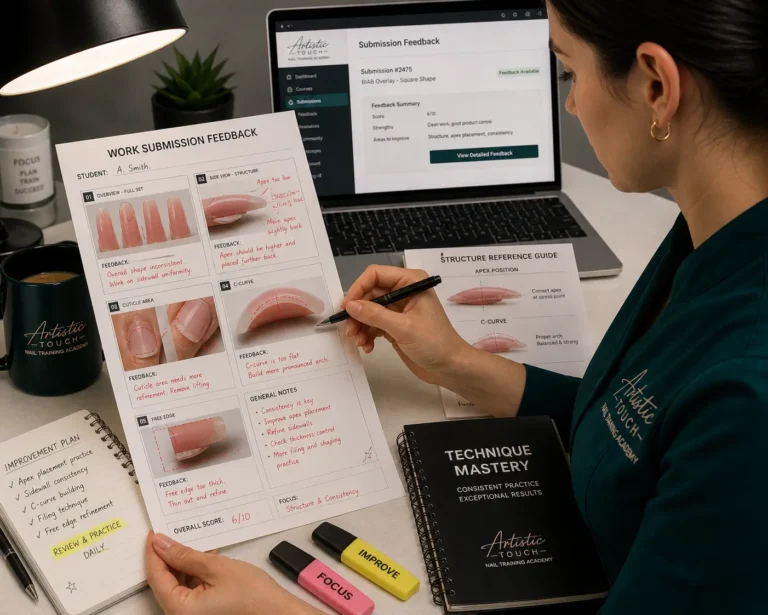
Symmetry is assessed from all angles — top view, side profile, and free edge view. A nail that looks acceptable from above but shows uneven thickness or poor volume distribution from the side is not considered professionally acceptable.
Where many students in the UK are often taught basic application steps — apply product, cure, file to shape — without the deeper structural understanding that explains why these steps matter or how to adapt when working on different nail types.
2. Structure vs Surface Results
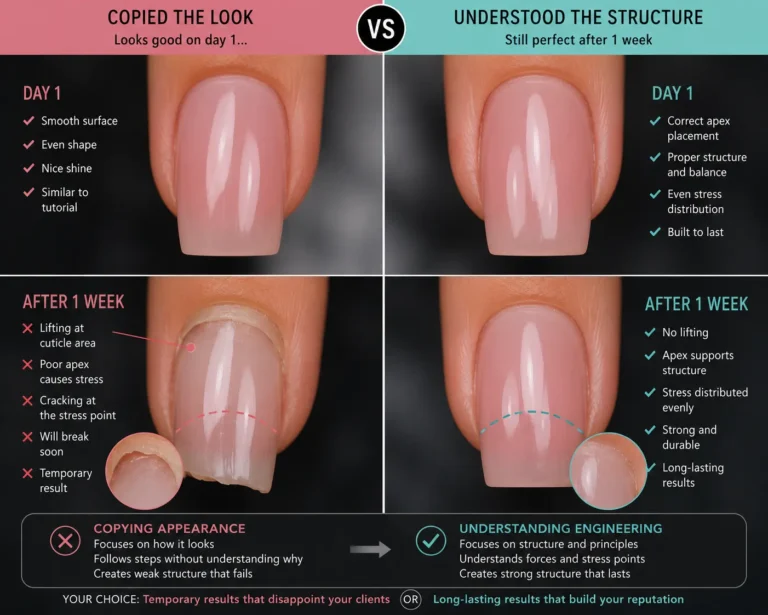
European training methods prioritise long-term wear and structural integrity over immediate visual results. You learn that a nail can look perfect in photos immediately after application but fail structurally within days if the foundation work was not correct.
Correct apex placement is taught based on nail anatomy and intended wear time. You understand that apex position affects how stress distributes during normal hand use, which influences whether enhancements crack at the smile line or lift at the cuticle area.
Nail architecture is approached systematically. You learn to assess the natural nail’s C-curve depth, sidewall angle, and stress point locations before selecting techniques or products. This assessment-first approach prevents structural failures caused by forcing techniques onto unsuitable nail types.
Where beginners are often shown what finished nails should look like without understanding why certain structural decisions create durability whilst others create weak points that fail under client wear.
3. Technique Explanation vs Silent Demonstration
One of the most significant differences I noticed when comparing European training methods to basic tutorial content is the presence of continuous explanation throughout every technique demonstration.
European-style education explains every movement. You hear why the cuticle pusher is angled at fifteen degrees, why the e-file bit moves in one direction at the sidewalls, why product is placed at the centre first before spreading outward. This constant reasoning builds your decision-making ability.
Correct terminology is used consistently. Eponychium and cuticle are not used interchangeably. Nail plate layers are named accurately. Product types are classified by their chemical composition, not just brand names. This precision in language creates precision in understanding.
Cause and effect relationships are taught explicitly. You learn that inadequate preparation causes lifting, excessive filing causes heat damage, improper cure creates brittleness. Understanding these connections allows you to troubleshoot problems when they occur.
Decision-making is emphasised over step-following. You develop the ability to assess a nail type, recognise which approach suits that specific situation, and adapt your technique accordingly — rather than copying the same steps regardless of the nail in front of you.
Lower-quality training often shows the process without explanation. You watch hands moving, products being applied, nails being filed — but you do not hear the reasoning. This leaves students guessing why their results do not match the demonstration or what to change when problems arise.
4. Continuous Upskilling Culture
In Eastern Europe, ongoing education is standard practice. Nail technicians regularly attend masterclasses to refine their skills, learn new systems, and stay current with modern techniques and safety protocols.
This culture of continuous professional development means education does not stop after your initial training. You return to advanced courses, specialist technique workshops, and product-specific masterclasses throughout your career. This keeps your skills sharp and your knowledge current.
I have continued this approach throughout my career, regularly training across Europe to bring the most advanced and safe methods into my teaching. Every masterclass I attend informs how I structure my own courses, which techniques I recommend, and how I explain concepts to students.
This commitment to ongoing learning ensures that the education I provide reflects current professional standards, not outdated methods or techniques that have been superseded by safer, more effective approaches.
Why This Matters for Your Results
The difference in training standards directly affects several aspects of your professional nail work. Understanding these impacts helps you recognise why depth of education matters more than surface-level familiarity with techniques.
Retention and longevity. Precision preparation and clean application create stronger adhesion. Nails prepared and applied using European precision methods typically last two to four weeks without lifting, whereas basic application often shows lifting within three to seven days.
Nail health. Technique precision protects the natural nail from damage. When you understand correct e-file angulation, appropriate pressure, and safe product placement, you avoid the thinning, burning, and structural damage that result from improper technique.
Client satisfaction. Clients notice when their nails last longer, look cleaner, and feel more comfortable. Professional precision creates results that clients can rely on, which builds trust and encourages long-term client relationships.
Your confidence as a technician. When you understand the structural reasoning behind techniques, you work with confidence even on challenging nail types. You know how to adapt rather than hoping the standard approach will work on every client.
Your ability to troubleshoot problems. Deep understanding allows you to identify why something went wrong and how to correct it. Surface-level knowledge leaves you repeating the same steps hoping for different results.
What You Gain from European-Standard Training at Artistic Touch
This precision-focused, explanation-driven approach is exactly what I bring into my training at Artistic Touch Nail Training Academy. My courses are not based on trends or shortcuts. They are built on European precision techniques, real salon experience, clear structured teaching, and safety-first application methods.
You are not just shown how to do a treatment — you understand why it works and how to adapt it to every client. Every course includes continuous voice-led explanation throughout every lesson, so you hear the reasoning behind each decision, not just the visual steps.
All training uses correct European anatomical and technical terminology from the beginning. You learn precise terms for nail structures, accurate product classifications, and professional language that builds clear understanding rather than confusion.
Structural principles are taught before application techniques. You understand apex placement, C-curve effects on volume, stress zone management, and how nail architecture influences technique selection. This foundation allows you to troubleshoot confidently when working on different nail types.
Safety and precision are integrated into every lesson. You learn clean application methods that avoid skin contact, proper e-file technique that prevents damage, and contraindication awareness that protects both client health and your professional reputation.
Training is informed by continuous European masterclass education. The methods I teach reflect current professional standards across European nail education, updated regularly through my ongoing advanced training and salon practice.

Understanding the Difference Changes Your Career
If you are choosing a nail training course, this is one of the most important things to understand. Not all education is built the same. The method behind the training will define your results, your confidence, and your future as a nail technician.
Surface-level courses show you what techniques look like. Professional European-standard training teaches you why they work, how to adapt them, and how to troubleshoot when situations differ from demonstrations.
The difference becomes visible the moment you work on your first client whose nails do not match the tutorial examples. If your training provided depth and reasoning, you adapt confidently. If your training only showed steps to copy, you struggle.
This is why I structure my courses the way I do — continuous explanation, correct terminology, precision focus, structural understanding, and safety integration. These are not optional extras. They are the foundation of professional competence.
When you train with methods built on European precision standards, you gain the ability to work confidently on diverse nail types, troubleshoot problems effectively, and build a sustainable practice based on client satisfaction and long-term results.
Frequently Asked Questions
What is the main difference between European nail training and basic UK courses?
European training emphasises precision cuticle work, clean application without skin contact, structural understanding of nail architecture, continuous explanation of technique reasoning, and ongoing professional upskilling. Basic courses often focus on demonstrating application steps without the depth of structural understanding, safety integration, or troubleshooting ability that European methods provide.
Why does precision in nail application matter?
Precision directly affects adhesion, longevity, and nail health. Clean application without skin contact reduces sensitisation risk and improves product bonding. Precise cuticle preparation creates a clean foundation for longer wear. Accurate apex placement and structural balance prevent lifting and breakage. Precision is not about perfectionism — it is about creating results that last and protect client nail health.
Do I need European training to become a good nail technician?
You need training that provides depth, structural understanding, continuous explanation, and precision focus — which are hallmarks of European educational methods. The geographic origin matters less than the educational approach. Look for courses that teach reasoning behind techniques, use correct terminology, integrate safety throughout, and provide ongoing support. These principles create professional competence regardless of where the educator is based.
How often should nail technicians take advanced training courses?
Professional nail technicians in Europe typically attend masterclasses or advanced training at least once or twice per year. This ongoing education keeps skills current, introduces new techniques and products, and maintains high professional standards. Continuous upskilling is considered standard practice in European nail culture, not an optional extra reserved for specialists.
What is clean application technique?
Clean application means controlling product placement so gel, builder gel, or polygel sits only on the nail plate without touching the proximal nail fold, hyponychium, lateral nail folds, or surrounding skin. This precision reduces sensitisation risk, improves adhesion by preventing product from curing on skin rather than nail, and creates professional-looking results. Clean application is a core principle in European precision methods.
Why is continuous explanation important in nail training?
Continuous explanation teaches you the reasoning behind each action, not just the visual steps. This builds decision-making ability and troubleshooting skills. When you understand why apex placement affects wear time, why filing direction matters, or why certain nails require different preparation, you can adapt techniques to different situations rather than copying steps that only work on ideal nail types shown in demonstrations.
Train with European Precision Standards
All Artistic Touch courses are built on precision-focused European training methods — continuous explanation, correct terminology, structural understanding, clean application techniques, and safety-first principles. Learn from an educator trained in Bulgaria who continues upskilling through European masterclasses.
View All Professional Courses →Lifetime access • Continuous explanation throughout every lesson • Private student support
About the Author

Radina Ignatova
Professional Nail Expert | International Nail Educator
I am Radina Ignatova, a Professional Nail Expert since 2014 and International Nail Educator, based in Scotland, UK. I am the Founder of Artistic Touch Nail Training Academy and TheNailWiki.
At Artistic Touch Nail Training Academy, I provide structured professional online nail courses specialising in dual forms, gel systems, polygel application, advanced nail structure, E-File work and Russian Manicure, with a strong focus on professional salon safety. I continue to work actively in salon practice, ensuring that all education reflects real client scenarios and current industry standards.
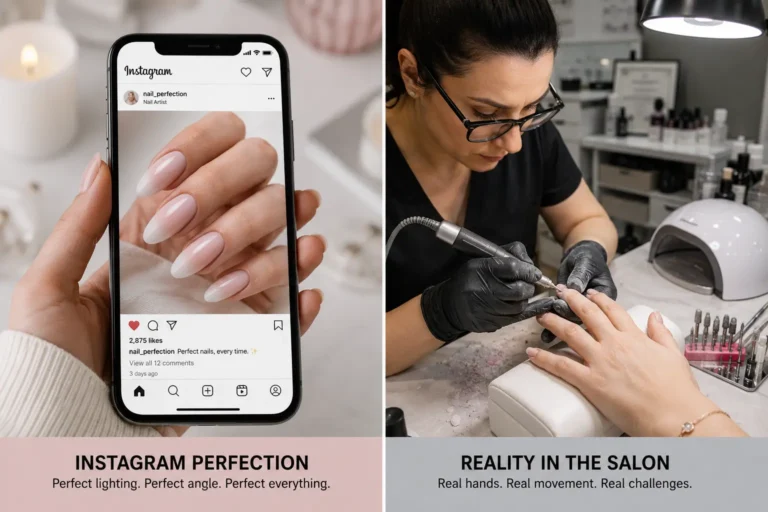
My teaching philosophy is simple: I show real salon challenges, real mistakes and real performance testing, not just perfect demonstrations. This is how you develop genuine technical competence and become a confident, capable nail professional.
Disclaimer: This content is for educational purposes only. Nail services should be performed by trained professionals following current hygiene and safety regulations. Always carry out a full client consultation and check for contraindications before performing any nail service.
About Artistic Touch Nail Training Academy
Artistic Touch Nail Training Academy delivers structured professional online nail education focused on practical skill development, professional standards and safe salon practice. All courses are available online worldwide.