How to Choose a Nail Training Course: What Most Students Do Not Realise

Quick Answer: What Should You Look for When Choosing a Nail Training Course?
Professional nail training courses should provide continuous voice-led explanation, use correct European terminology, integrate safety throughout every lesson, teach structural understanding rather than just steps to copy, and clearly distinguish between free demonstration content and paid comprehensive training.
Understanding these differences helps you identify courses that build real competence rather than surface-level familiarity.
Why Many Students Struggle After Completing Nail Courses
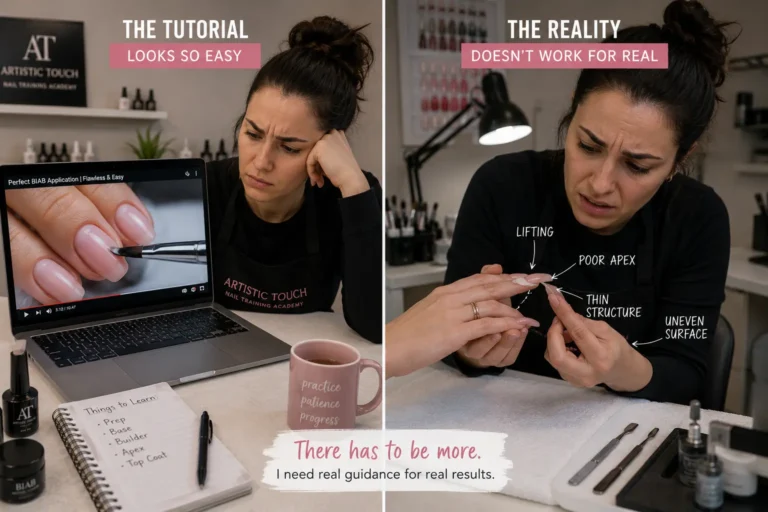
Most students enrol in nail training courses expecting to gain professional competence. They complete the course, watch every video, and attempt to apply what they have learned. Then they encounter real client scenarios — different nail types, unexpected complications, results that do not match what they saw demonstrated — and they realise something is missing.
They blame themselves. They assume the problem is their technique, their product choice, or their lack of experience. What they do not realise is that the course itself may not have provided the depth of education required for real professional work.
Many nail training courses focus on showing finished results rather than teaching the decisions, the reasoning, and the structural understanding that create those results. Students learn what a nail should look like when it is finished, but they do not learn how to assess, troubleshoot, or adapt when working on different clients.
What Separates Professional Nail Education from Surface-Level Courses
Professional nail education is not about copying steps from a demonstration. It is about understanding what is happening at each stage, why it matters, and how to adapt your approach when faced with different nail types, different challenges, or different outcomes.
The difference between professional training and surface-level courses becomes clear when you work on your first client whose nails do not match the tutorial examples. If your training was thorough, you understand how to assess the situation and adjust your technique. If your training only showed you what to do without explaining why, you are left guessing.
Here are the key factors that distinguish professional nail education from courses that only provide surface-level familiarity.
1. Correct Terminology and European-Trained Standards
Many online nail courses are translated from other languages or created by educators who learned through informal channels rather than structured professional training. This creates confusion through incorrect or inconsistent terminology.
When an educator uses incorrect terms — calling the eponychium “the cuticle” when these are anatomically different structures, or using product names interchangeably when they have different chemical compositions — students develop a flawed understanding that undermines their ability to communicate professionally and apply techniques correctly.
European-trained nail educators use precise, anatomically correct terminology because this is how professional nail work is taught and practised across the European nail industry. When you learn with correct terminology from the beginning, you develop a clear mental framework for understanding nail anatomy, product behaviour, and technique application.
This clarity improves your confidence, your ability to troubleshoot problems, and your professional communication with clients and suppliers. You are not constantly translating or second-guessing whether the term you learned matches what professionals actually use.
2. Continuous Explanation — Not Silent Demonstration
One of the most significant differences between professional training and basic demonstration content is the presence of continuous voice-led explanation throughout the lesson.
Many nail courses rely on long silent video clips set to music. You watch hands moving, product being applied, and nails being filed, but you do not hear the reasoning behind each action. You see what is happening, but you do not understand why it is happening, when to do it differently, or what to look for if something goes wrong.
Professional nail education provides constant guidance. The educator explains what is happening at each stage, why this step matters, what you should be observing, and how to adapt if the nail type or situation requires a different approach.
This continuous explanation creates several important benefits. You learn faster because you are not left trying to decode what you are seeing. You make fewer mistakes because you understand the cause-and-effect relationships between actions and outcomes. You develop confidence because you know not just what to do, but why you are doing it.
When you encounter a nail that does not behave the way the demonstration showed, you can troubleshoot effectively because you understand the underlying principles — not just the surface steps.
3. Safety Integrated Throughout — Not Added as an Afterthought
Many nail training courses focus exclusively on achieving finished results. Safety protocols, contraindication awareness, and damage prevention are either omitted entirely or mentioned briefly at the beginning and then ignored throughout the practical demonstrations.
Professional nail education integrates safety into every lesson. You learn how to avoid damaging the natural nail whilst preparing the surface. You understand why certain products should not contact the skin and how to control placement throughout application. You recognise when a technique is unsuitable for a particular nail type or when a client’s nail condition requires a different approach.
This safety-first approach is not about creating fear or adding unnecessary steps. It is about understanding how nails respond to different treatments, how products behave on skin versus nail plate, and how to work in ways that protect both the client’s nail health and your professional reputation.
When safety is integrated into your training from the beginning, it becomes a natural part of your technique — not something you have to remember separately or apply inconsistently.
4. Depth of Understanding — Not Just Steps to Copy
Surface-level nail courses show you a sequence of steps. Apply this product, file this way, cure for this long. If the steps work exactly as demonstrated, the result looks acceptable. If anything differs from the demonstration — different nail shape, different product brand, different environmental conditions — you have no framework for adapting.
Professional nail education teaches you the structural principles behind the technique. You learn why apex placement matters for different nail shapes. You understand how C-curve depth affects volume distribution in sandwich dual forms. You recognise what proper product cure looks like and how to assess whether structure is correct before the client leaves.
This depth of understanding gives you the ability to troubleshoot. When a nail lifts after three days, you can assess whether the problem was in preparation, product choice, application technique, or client aftercare — because you understand how each factor contributes to adhesion and longevity.
You can work confidently on clients with flat nail beds, naturally curved nails, short nail plates, or any variation from the “ideal” nail shown in basic demonstrations — because you understand the principles well enough to adapt your approach.
5. Free Content Shows How I Teach — Paid Courses Fully Train You
There is an important distinction between free demonstration content and paid professional training. Understanding this distinction helps you evaluate what you should expect from each.
Free content — tutorials on YouTube, Instagram demonstrations, TikTok clips — shows you what a technique looks like when performed correctly. It demonstrates the finished result, highlights key moments in the process, and gives you a sense of the educator’s teaching style and approach.
This free content serves a specific purpose. It builds your familiarity with techniques before you commit to paid training. It shows you how the educator communicates and whether their teaching style matches the way you learn. It provides value by demonstrating concepts and showing what is possible.
But free content is demonstration, not comprehensive training. It shows you the highlights without the depth. It presents finished results without the full context of preparation, decision-making, troubleshooting, and adaptation that makes those results possible in real salon work.
Paid professional training provides the complete system. You receive structured lessons that build progressively, covering preparation, product knowledge, technique application, troubleshooting, and client management. You gain access to ongoing support where you can ask questions, submit your work for feedback, and receive guidance specific to the challenges you encounter.
The distinction is not about withholding information. It is about recognising that watching a demonstration and receiving comprehensive professional training are fundamentally different educational experiences with different outcomes.
If you want to see how I teach before committing to a course, visit my YouTube channel or explore the free mini masterclasses available on the Artistic Touch website. These resources show you the teaching style, the depth of explanation, and the approach to technique that carries through into the paid professional courses.
6. Real Salon Experience and Professional Reasoning
Professional nail educators who continue to work actively in salon practice bring a level of insight that cannot be replicated by educators who only teach or who learned exclusively from other courses.
When an educator shows you a technique and explains not just what works but what commonly goes wrong, why clients request certain modifications, how different product brands behave in real application, and which shortcuts create problems three weeks later — that knowledge comes from years of salon work with hundreds of different clients.
This real-world experience means lessons include context you will not find in courses created by educators who learned only through formal training without extensive client-facing work. You learn the practical adaptations, the common client concerns, the product behaviours that only become apparent through repeated professional use.
You skip years of trial-and-error learning because the educator has already encountered these situations, identified the patterns, and developed reliable approaches that work consistently across different nail types and client needs.
How to Evaluate a Nail Training Course
When you are considering enrolling in a nail training course, these questions will help you assess whether the course provides professional-level education or surface-level demonstration.
Does the educator provide continuous voice-led explanation throughout lessons? Or are lessons primarily silent demonstrations set to music? Professional training requires constant guidance and reasoning, not just visual demonstration.
Does the course use correct anatomical and technical terminology consistently? Check whether the educator distinguishes between eponychium and cuticle, whether product types are named correctly, and whether terminology matches professional industry standards.
Is safety integrated into every technique lesson? Or is safety mentioned once at the beginning and then ignored during demonstrations? Professional education treats safety as inseparable from technique, not as a separate topic.
Does the course teach structural principles and decision-making? Or does it only show steps to copy? Ask yourself whether you would know how to adapt the technique if faced with a nail type different from what is demonstrated.
Does the educator continue to work in active salon practice? Educators who work with real clients bring insights that pure teaching-focused educators cannot replicate. This practical experience shows in the depth and relevance of the content.
Is there ongoing support after course completion? Professional training includes access to guidance when you encounter challenges during practice. Courses that provide content without ongoing support leave you to solve problems alone.
What Professional Nail Training Looks Like at Artistic Touch
At Artistic Touch Nail Training Academy, professional education is built on the principles outlined in this article. Every course provides continuous voice-led explanation throughout every lesson, so you understand not just what is happening but why it matters and how to adapt.
All training uses correct European terminology from the beginning. You learn precise anatomical terms, accurate product classifications, and professional technical language that builds a clear framework for understanding nail work.
Safety is integrated into every technique lesson. You learn how to avoid damage, recognise contraindications, control product placement, and work in ways that protect both nail health and your professional reputation. This safety-first approach is not added as an afterthought — it is woven into the way techniques are taught from the start.
Courses focus on structural understanding and decision-making, not just steps to copy. You learn why apex placement matters, how C-curve affects volume, what correct preparation looks like, and how to troubleshoot when results do not match expectations. This depth gives you the confidence to adapt techniques to different nail types and client needs.
Training is informed by continuous salon practice. Lessons include real client scenarios, common challenges, product behaviours observed through professional use, and the practical reasoning developed through years of working with diverse nail types.
Every student receives lifetime course access and membership in a private support group where questions are answered, work is reviewed, and guidance is provided throughout your learning journey. Professional education does not end when you finish watching the videos — it continues as you practise and develop your skills.
All professional Masterclass courses at Artistic Touch are built on these principles — from dual forms and BIAB systems to E-File work and Russian Manicure. Each course provides the depth, support, and structured progression required for genuine professional competence.
Understanding the Difference Changes Your Results
The gap between surface-level courses and professional nail education becomes visible the moment you start working on real clients. If your training only showed you what to do, you will struggle when faced with nails that do not match the demonstration examples.
If your training taught you why techniques work the way they do, how to assess and adapt, and how to troubleshoot when problems arise, you will work with confidence even when situations differ from what you practised.
Professional nail education is an investment in genuine competence. It provides the depth of understanding that allows you to build a sustainable practice, maintain high professional standards, and continue developing your skills throughout your career.
When you choose training that prioritises correct terminology, continuous explanation, integrated safety, structural understanding, and real-world experience, you are choosing education that creates professional capability — not just familiarity with techniques.
Explore Professional Nail Training at Artistic Touch
All Artistic Touch Masterclass courses are built on the principles outlined in this article — continuous explanation, correct European terminology, integrated safety, structural understanding, and real salon experience. Choose from dual forms, BIAB systems, E-File work, Russian Manicure, and more.
View All Professional Courses →Lifetime access • Private student community • Direct access to Radina • Start immediately
Frequently Asked Questions
What is the difference between free nail tutorials and paid nail courses?
Free tutorials demonstrate techniques and show finished results, providing familiarity with what is possible. Paid professional courses provide structured progressive training, continuous explanation of reasoning and principles, troubleshooting guidance, safety integration, and ongoing support. Free content shows you what a technique looks like; paid courses teach you how to perform it correctly and adapt it to different situations.
How do I know if a nail course uses correct terminology?
Check whether the educator distinguishes between the eponychium and the cuticle, uses precise anatomical terms for nail structures, and names products by their technical classification rather than brand names alone. Correct terminology should be consistent throughout all course content. If terminology varies or seems unclear, this indicates the course may not provide professional-standard education.
Why does continuous explanation matter in nail training?
Continuous voice-led explanation teaches you the reasoning behind each action, not just the visual steps. This allows you to understand why techniques work, how to adapt them to different nail types, and what to do when results differ from demonstrations. Silent demonstrations show you what is happening but do not teach you how to think through decisions or troubleshoot problems.
Should I choose courses from educators who work in salons?
Educators who continue active salon practice bring real-world experience that informs their teaching. They understand common client challenges, product behaviour in professional use, and practical adaptations developed through working with diverse nail types. This experience adds depth and relevance that pure teaching-focused educators cannot replicate. However, ensure the educator also has strong teaching skills and structured course design.
What does safety-led nail training mean?
Safety-led training integrates damage prevention, contraindication awareness, and product safety into every technique lesson rather than treating safety as a separate topic mentioned once. You learn how to prepare nails without causing damage, control product placement to avoid skin contact, recognise when techniques are unsuitable for specific nail conditions, and work in ways that protect both client nail health and professional standards.
How important is ongoing support after completing a nail course?
Ongoing support is essential for developing professional competence. When you practise techniques on your own clients, you will encounter situations that differ from course demonstrations. Access to ongoing guidance allows you to ask questions, submit work for review, and receive feedback specific to your challenges. Courses without ongoing support leave you to solve problems alone, which slows skill development and increases frustration.
About the Author

Radina Ignatova
Professional Nail Expert | International Nail Educator
I am Radina Ignatova, a Professional Nail Expert since 2014 and International Nail Educator, based in Scotland, UK. I am the Founder of Artistic Touch Nail Training Academy and TheNailWiki.
At Artistic Touch Nail Training Academy, I provide structured professional online nail courses specialising in dual forms, gel systems, polygel application, advanced nail structure, E-File work and Russian Manicure, with a strong focus on professional salon safety. I continue to work actively in salon practice, ensuring that all education reflects real client scenarios and current industry standards.
My teaching philosophy is simple: I show real salon challenges, real mistakes and real performance testing, not just perfect demonstrations. This is how you develop genuine technical competence and become a confident, capable nail professional.
Every Artistic Touch course includes lifetime access and access to a dedicated student support group, where I provide ongoing guidance and professional feedback.
Disclaimer: This content is for educational purposes only. Nail services should be performed by trained professionals following current hygiene and safety regulations. Always carry out a full client consultation and check for contraindications before performing any nail service.
About Artistic Touch Nail Training Academy
Artistic Touch Nail Training Academy delivers structured professional online nail education focused on practical skill development, professional standards and safe salon practice. All courses are available online worldwide.