AI vs Freehand: I Used AI to Design a Nail Art Competition Entry — Then Built It Entirely by Hand
Quick Answer: Can AI Design Nail Art?
AI can generate a visual reference image, but it cannot create physical nail art. In this project, AI was used purely as a visualisation tool — it took 40 minutes of prompting to produce an image close enough to my concept to use as a working reference. It then took 5 hours of skilled hand work to actually build the nail.
The full process — from first prompt to finished competition nail — is in the video below and explained in detail in this article.
Watch: AI vs Freehand — The Full Build
Watch the complete 5-hour build condensed into under 20 minutes. This is the full process from the first gel layer to the finished editorial nail — including the moments that did not go to plan, the materials that behaved unexpectedly, and what changed along the way.
Why I Used AI — and What It Actually Did
Whenever I create nail art, I need something visual to work from. It keeps me on track with the idea I am trying to achieve. Normally that reference comes from a sketch, a photograph, or a mood board. For this project — a competition entry for Scratch magazine’s February Scratch Snap, themed Nature with a Twist — I decided to try using an AI image generator instead.
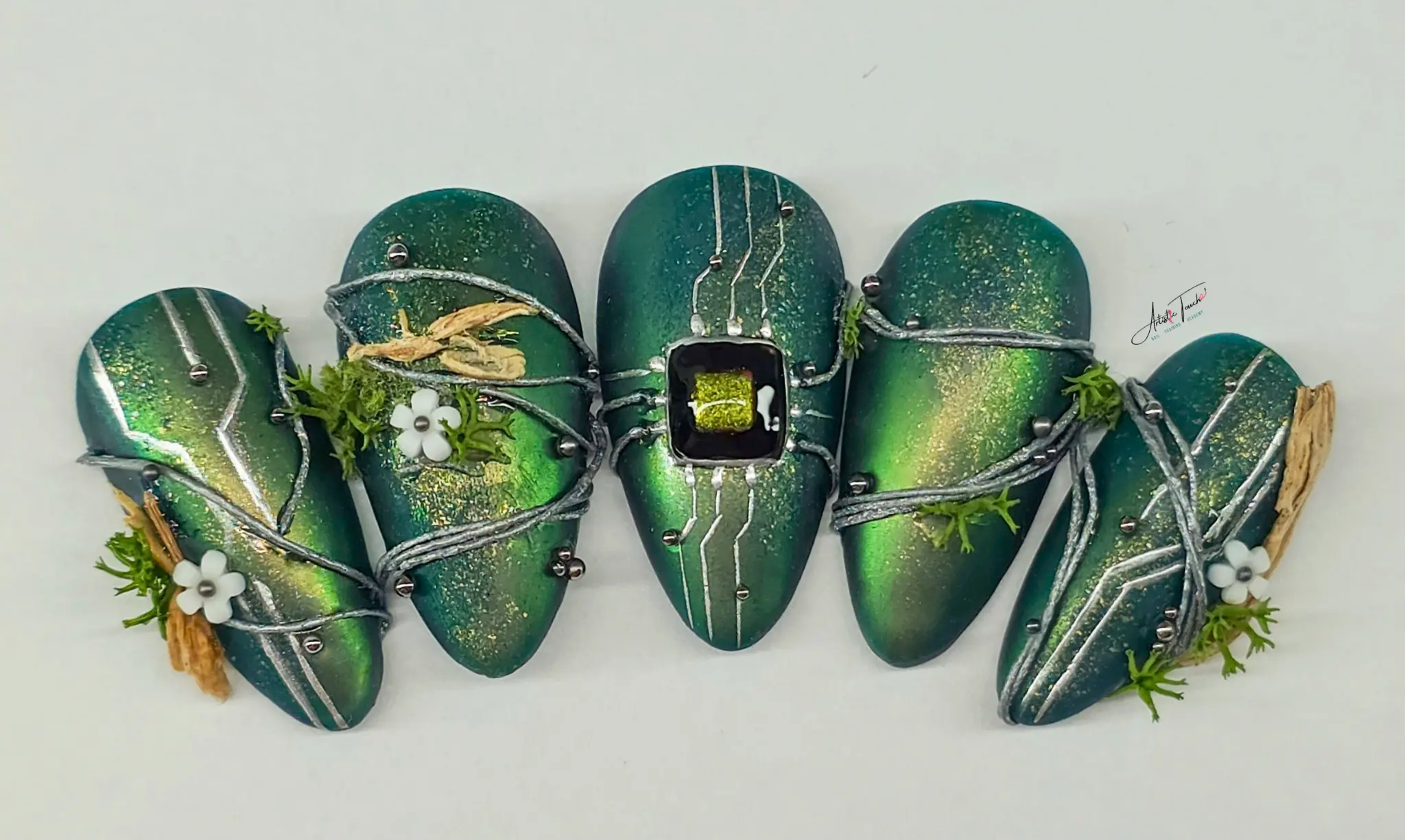
I had a clear concept in my mind: a computer chip at the centre of the nail, with wires braiding outward and nature pushing through from underneath. The idea was that AI had tried to take over, but nature was not allowing it to do so. I typed that idea into an AI image generator and started prompting.
It took 40 minutes of iterative prompting to produce an image that was close enough to the vision in my head to use as a working reference. That number is worth sitting with. Forty minutes — just to get the AI to generate a picture of something I could already see clearly in my own mind.
What I ended up with was a useful starting point. Not a perfect blueprint, but enough of a visual anchor to begin building. The creation itself took approximately 5 hours in real life. Every single element in the finished nail was made by hand.
The Concept: Nature with a Twist
The competition theme was nature with a twist, and my interpretation was deliberately confrontational. A computer chip — precise, cold, and technological — sits at the centre of the nail as the focal point. Wires twist and braid outward from it, coated in silver gel and set in movement. Around and through them, nature encroaches: moss, dried botanical fragments, roots.
The concept was that AI had attempted to dominate but nature was coming through and refusing to be suppressed. The chip is the masterpiece of the composition. Everything else — the wires, the moss, the roots — tells the story of what is growing around it.
These nails are entirely editorial. They were built purely for this specific creative competition and are not a wearable design. That distinction is important: editorial nail art operates under different rules from salon work, and the freedom it allows is part of why the process is worth documenting.
How the Nail Was Built — Material by Material
The Base
The base was green gel polish, mattified and finished with chrome green powder. A silvery shimmer polish was applied to begin sketching some of the compositional lines before the structural work began.
The Computer Chip
The chip was built using a thick 3D gel — the kind normally used to adhere rhinestones — applied over a silver outline drawn directly onto the nail. It was built up in layers to create real dimension, then filed back to flatten the surface slightly, painted in black gel polish, tidied with a detail brush, and fully cured.
The core of the chip required a different approach. No gel polish I owned was vivid enough to create the effect I wanted, so I used a bright green nail foil applied over a small square rhinestone. The foil process was extremely fiddly — multiple coats over a very small surface area — but the result was the intense green the composition needed.
The Circuit Tracks
The tracks extending outward from the chip were painted using a fine liner detail brush loaded with metallic silver paint. These represent hardware connections extending to the rest of the composition and add the technical detail that makes the chip read as a chip rather than simply a raised rectangular shape.
The Wires
The wires were made from eyebrow threading thread — the thicker variety used for men’s hair — soaked in silver gel and cured in a nail lamp for a minimum of 2 × 60 seconds. They needed to be completely set before handling.
Each wire was positioned using flash-cured gel to hold it in place. Groups of three threads were twisted together to create a braided, coiled effect. The ends were tucked under the nail and secured rather than cut flush, which kept the composition clean and allowed the wires to appear to grow outward naturally.
I had to create more wires mid-project than I had originally prepared. That kind of adjustment is entirely normal in editorial work — the composition changes as it takes physical form, and you have to respond to what you are actually seeing rather than the image you started from.
The Nature Elements
The moss was a replacement for the original material I had purchased. The first was more fabric-like than realistic. The second — bought the following day — had a genuinely organic texture. I cut it into very small fragments and applied each piece individually using matte top coat, which prevented shine from the adhesive medium showing through and disrupting the surface consistency.
Black caviar beads were used to add technical detail. The dried botanical elements on the end nails were the most challenging material: real dried roots that absorbed product completely differently from anything else and would not adhere through conventional means. Getting them to sit correctly took considerable time.
Pre-made 3D flowers were added last, modified where necessary to ensure the computer chip remained the dominant focal point of the composition.
What This Project Shows About AI as a Creative Tool
AI is a visualisation tool. Used in the right way, it can externalise an idea faster than sketching and produce a reference image you can work from. For someone who — like me — needs something visual to begin, that has genuine value.
What AI cannot do is any of the actual work. It cannot select the right gel consistency for a structural build. It cannot manage the way an eyebrow thread absorbs silver gel during curing. It cannot respond to a composition that is not developing as planned and make real-time decisions about what to change. It cannot work with materials that behave unexpectedly and problem-solve in the moment.
“Inspiration without skill is just an image. Technique is what turns the vision into something real.”
— Radina Ignatova
The gap between the AI image and the physical nail is filled entirely by technical knowledge, material understanding, and hours of precise hand work. That gap is where skill lives — and it is what this series, AI vs Freehand, will continue to explore.
Materials Used in This Build
- Green gel polish — base colour across all nails
- Chrome green powder — applied over the cured gel base for depth
- Silvery shimmer gel polish — preliminary compositional lines
- Thick 3D gel — structural build for the computer chip
- Black gel polish — chip surface and detail work
- Metallic silver paint with fine liner brush — circuit tracks
- Green nail foil on square rhinestone — chip core
- Eyebrow threading thread (thick variety) — wires soaked in silver gel
- Matte top coat — surface finish and moss adhesion medium
- Black caviar beads — technical detail elements
- Realistic faux moss — nature element, cut into micro fragments
- Real dried botanicals including roots — end nail nature elements
- Pre-made 3D flowers — modified and applied last
Want to Develop Your Nail Art and Technical Skills?
Artistic Touch Nail Training Academy offers professional online nail courses covering gel systems, dual forms, e-file technique, Russian Manicure, and more — taught from real salon practice, not studio demonstrations.
View All Courses →Lifetime access • Certificate of completion • Private student community • Direct access to Radina • Start immediately
Frequently Asked Questions
What is the AI vs Freehand series?
AI vs Freehand is a creative series where I take an AI-generated nail design image and recreate it entirely by hand in real life. Each episode documents the full process — from the AI prompt to the finished physical nail — and examines what it actually takes to bridge the gap between a digital concept and a physical creation.
How long did this nail art take to build?
The physical build took approximately 5 hours. Generating the AI reference image through iterative prompting took 40 minutes. The entire 5-hour build is condensed into under 20 minutes in the video above.
Are these nails wearable?
No. This is editorial nail art built purely for creative expression and a specific competition entry. It is not designed to be worn by a client. Some of the materials and methods used — including flash curing away from the skin — are only appropriate in this specific non-wearable editorial context.
What competition was this created for?
This was created for the Scratch Snap nail art competition run by Scratch magazine. The February competition theme was Nature with a Twist. Scratch Snap is a regular nail art challenge that invites professional nail technicians to submit creative work around a set theme.
Where can I learn more about professional nail techniques?
Artistic Touch Nail Training Academy offers fully online professional nail courses covering a range of techniques and systems. All courses include lifetime access, a certificate of completion, and access to a private student community. View all available courses here.
About the Author
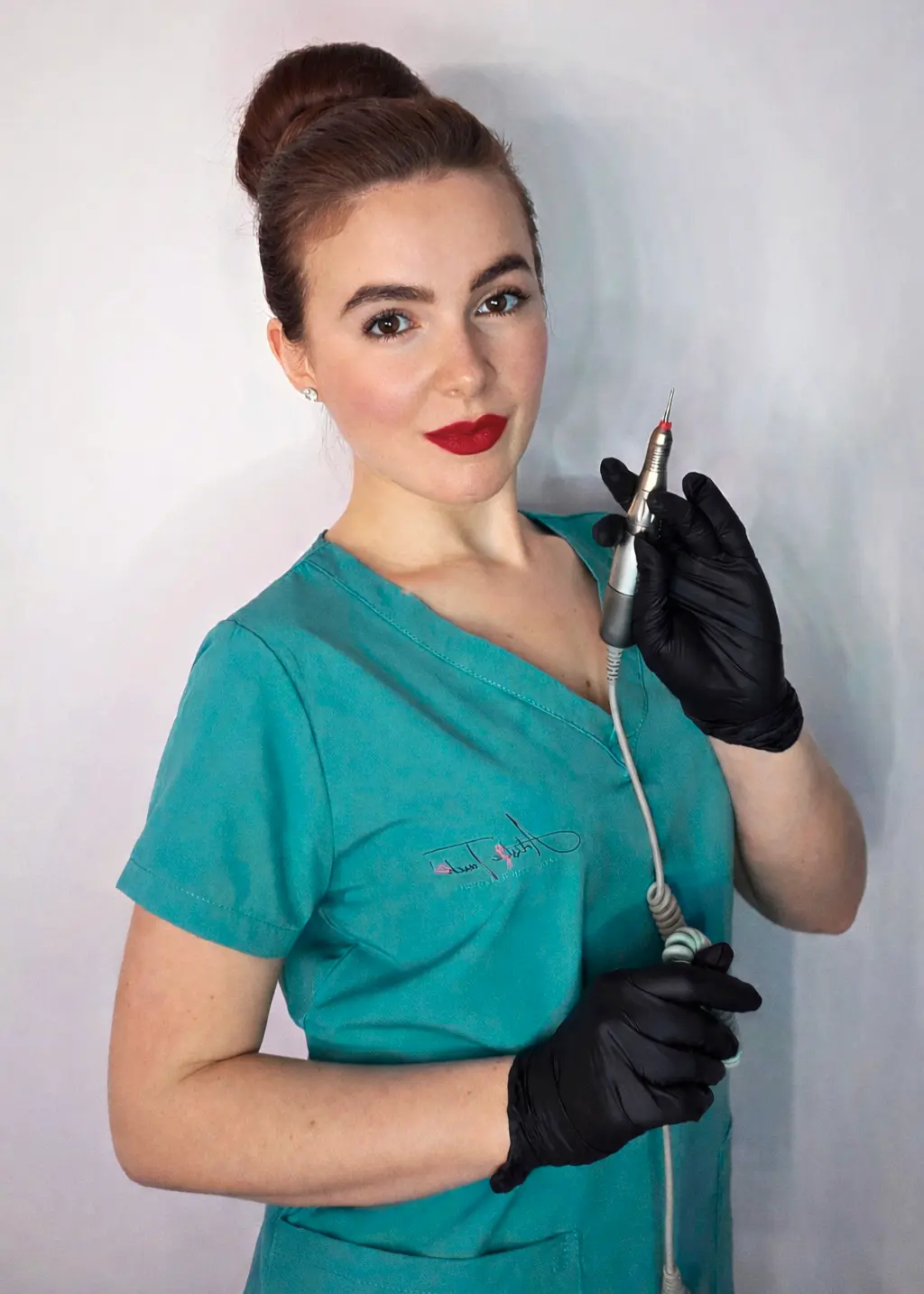
Radina Ignatova
Professional Nail Expert | International Nail Educator
I am Radina Ignatova, a Professional Nail Expert since 2014 and International Nail Educator, based in Scotland, UK. I am the Founder of Artistic Touch Nail Training Academy and TheNailWiki.
At Artistic Touch Nail Training Academy, I provide structured professional online nail courses specialising in dual forms, gel systems, advanced nail structure, e-file work and Russian Manicure, with a strong focus on professional salon safety. I continue to work actively in salon practice, ensuring that all education reflects real client scenarios and current industry standards.
My teaching philosophy is straightforward: I show real salon challenges, real mistakes and real performance testing — not polished demonstrations. This is how you develop genuine technical competence and become a confident, capable nail professional.
Every Artistic Touch course includes lifetime access, a certificate of completion and access to a dedicated student support group, where I provide ongoing guidance and professional feedback.
Note: The flash-cure technique used in parts of this build was applied only because these nails were editorial and were not applied near a human nail or skin. This method is not appropriate for client services. Always follow correct safety protocols in any professional nail service.
About Artistic Touch Nail Training Academy
Artistic Touch Nail Training Academy delivers structured professional online nail education focused on practical skill development, professional standards and safe salon practice. All courses are available online worldwide.