Why Most Online Nail Courses Fail Students (And What to Look For)
Author: Radina Ignatova, Professional Nail Expert | Last Updated: January 2026
Quick Answer: Why Do Most Online Nail Courses Fail?
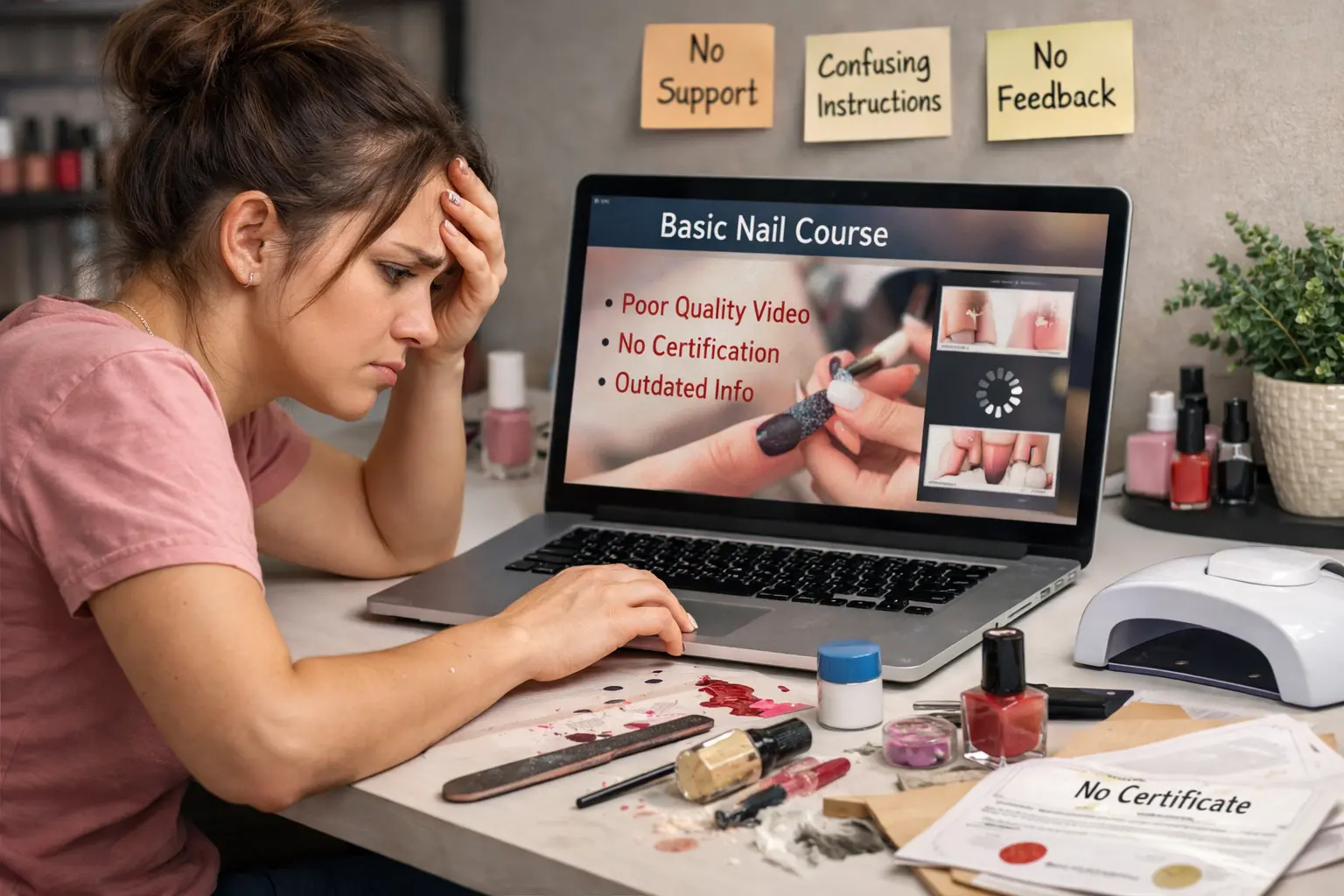
Most online nail courses fail students because they prioritise visual perfection over educational value, hide mistakes that learners need to see, provide zero troubleshooting guidance, and offer no ongoing support after purchase.
After 12 years of professional salon work and training over 200 students, I have seen the same patterns repeatedly: students arrive at professional training having completed multiple online courses but still cannot perform basic techniques safely or troubleshoot common problems.
This article reveals the exact failures in online nail education and the specific criteria you must evaluate before investing in any course.
Contents
The Uncomfortable Reality of Online Nail Training
I need to tell you something that most nail educators will not say publicly: the majority of online nail courses available today are not preparing students for professional work.
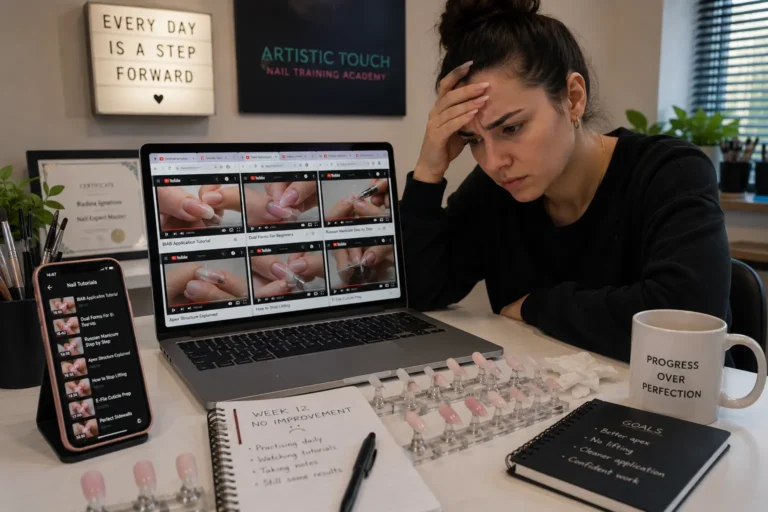
Over the past five years, I have trained hundreds of students who arrive with the same story. They have completed one, sometimes three or four online courses. They have watched hours of beautifully edited videos showing perfect nail applications. They have paid £200, £500, even £1,000 for access to video libraries.
And yet, when they attempt to work on real clients with real nails that do not behave like the demonstrations, they cannot troubleshoot the problems that arise. Their BIAB lifts after four days. Their e-file work causes client discomfort. Their cuticle prep is either too aggressive or ineffective.
The course did not fail because the student was not talented. The course failed because it was designed to look impressive rather than to educate effectively.
⚠️ The £3,000 Problem
The average student I train has already spent between £1,500 and £3,000 on previous online courses, products, and equipment before realising they still cannot work professionally. This is money that could have been invested in comprehensive, effective training from the beginning.
This article is not written to discourage online learning. I deliver online training myself, and when done correctly, online education is extraordinarily effective. This article exists to help you distinguish between courses that will genuinely develop your skills and those that will leave you frustrated, confused, and unable to work professionally despite your investment.
The 8 Critical Failures of Most Online Nail Courses
After analysing dozens of online nail courses and training students who have completed them, I have identified eight consistent failures that predict whether a course will successfully prepare students for professional work.
1. They Show Only Perfect Results (Never the Mistakes You Need to See)
This is the most damaging failure in online nail education, and it is nearly universal.
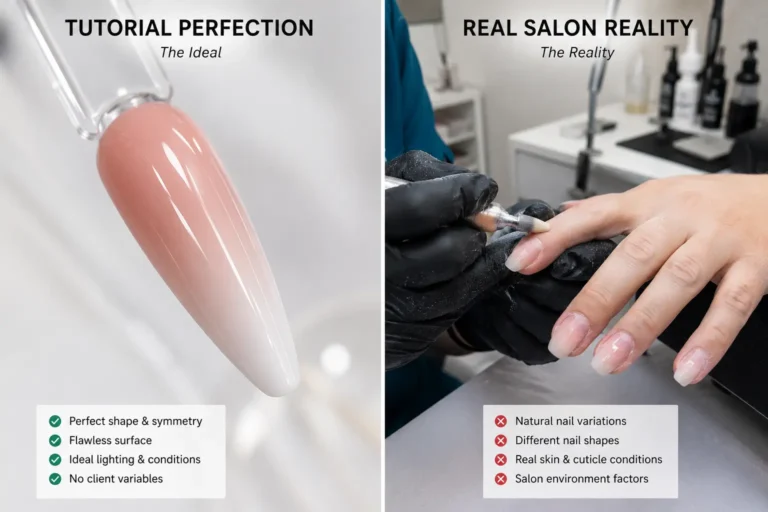
When you watch a typical online nail course, you see flawless demonstrations. The product applies smoothly. The cuticles are already perfectly prepared. The nail shape is ideal. The lighting is professional. The finished result is magazine-worthy.
What you do not see:
- What happens when the product starts to cure too quickly
- How to recognise when you are removing too much cuticle
- What early lifting looks like and why it occurs
- How to adapt technique when the nail plate curves unexpectedly
- What pressure feels like when it is causing client discomfort
- How to correct a mistake mid-application
In my 12 years of professional salon work, I have never completed a perfect application on the first attempt when learning a new technique. Not once. Skill development requires seeing what goes wrong and understanding why it happened and how to fix it.
When educators only show you the successful result, they rob you of the most valuable learning: the troubleshooting process that separates competent technicians from those who panic when something does not go according to plan.
Why Educators Hide Mistakes
Course creators believe that showing only perfect results makes them appear more skilled and their course more valuable. The opposite is true. Educators who show real mistakes and explain exactly how to identify and correct them demonstrate genuine mastery and teaching ability.
2. The Instructor Has Limited Real-World Salon Experience
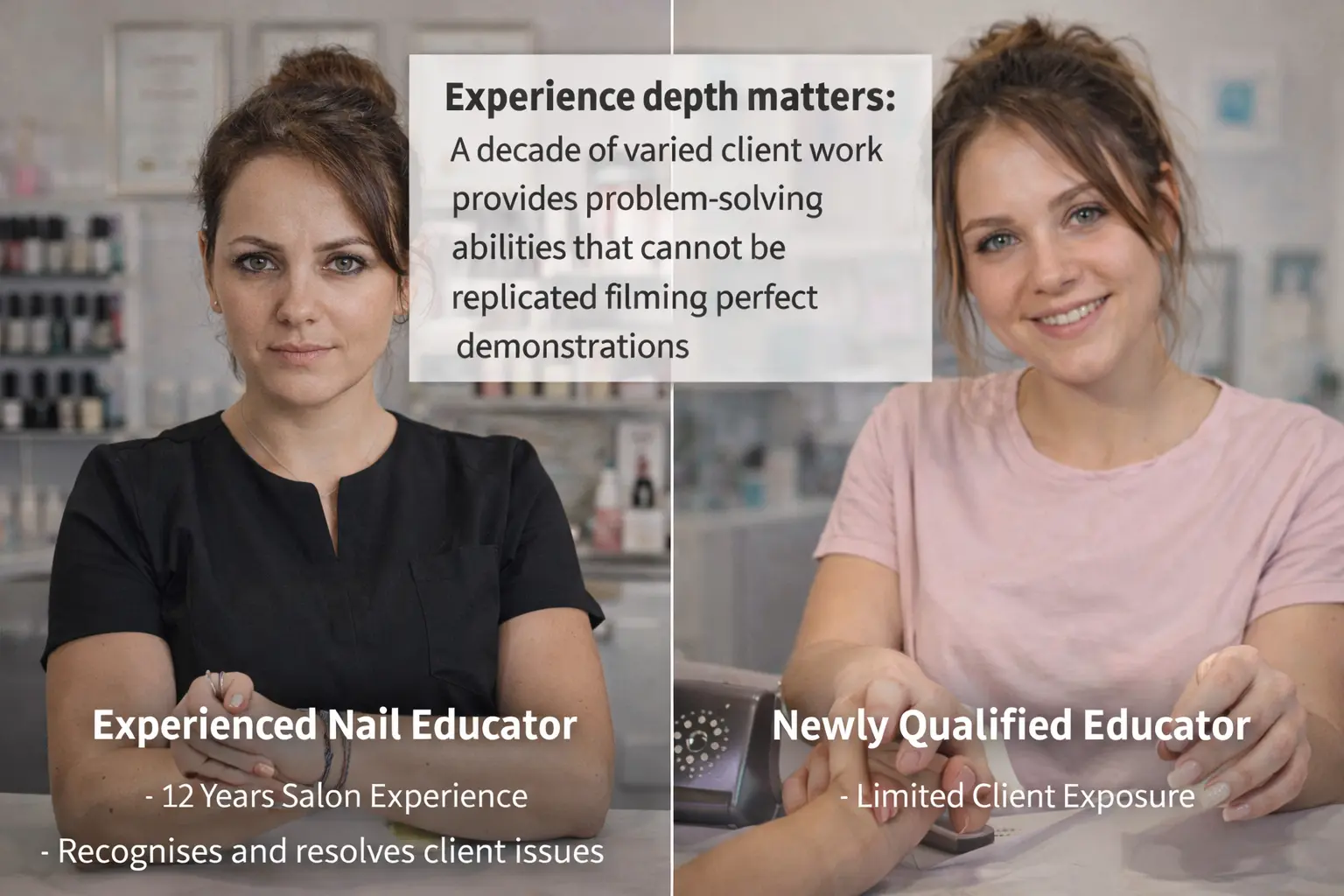
There is a growing phenomenon in nail education that concerns me deeply: educators who learn a technique, film themselves performing it a dozen times until they achieve one perfect result, then immediately begin teaching that technique to others.
They have never performed that technique on 100 different clients with 100 different nail types, concerns, and expectations. They have not encountered the nail that curves so severely that standard application fails. They have not worked with the client whose natural oils cause lifting within 48 hours no matter what preparation method is used. They have not faced the time pressure of a fully booked salon day.
Real expertise comes from volume and variety of experience. It is developed through years of client work, not through filming tutorials in controlled conditions.
When evaluating an online course, investigate the instructor’s background:
- How many years have they worked in a professional salon environment? (Not teaching—working with paying clients)
- Do they currently maintain a client base? (If they stopped doing salon work years ago, their knowledge may be outdated)
- What is their professional background? (Qualifications, industry recognition, professional affiliations)
- Can they show evidence of varied client work? (Not just their own nails or models, but diverse real clients)
3. They Provide No Structure or Learning Pathway
Many online courses are simply video libraries. Fifty, 100, even 200 videos uploaded with minimal organisation. The student is expected to “watch everything” and somehow absorb professional-level skills.
This is not education. This is content dumping.
Effective learning requires careful sequencing. You must master foundational concepts before attempting advanced techniques. You need to understand nail anatomy before learning cuticle prep. You need to understand product chemistry before troubleshooting lifting.
When evaluating a course, look for:
- Clear module structure organised by skill progression
- Prerequisites stated explicitly (“Complete Module 2 before attempting Module 5”)
- Learning objectives defined for each section
- Practice milestones with specific criteria for moving forward
- Assessment or feedback mechanisms to verify understanding before progression
4. You Cannot Evaluate Teaching Quality Before Paying
One of the riskiest aspects of online education is committing hundreds of pounds without any way to evaluate whether the instructor’s teaching style actually works for you.
Many course creators hide everything behind paywalls. You cannot see how they explain concepts, whether their demonstrations are clear, if their pace suits your learning speed, or whether their approach addresses your specific concerns—until after you have paid.
This is backwards. You should be able to evaluate an educator’s knowledge depth, teaching clarity, and problem-solving approach before making a financial commitment.
Quality educators demonstrate their expertise openly through:
- Free YouTube tutorials showing their teaching methodology and explanation style
- Free mini masterclasses that address real problems with detailed solutions
- Comprehensive educational wikis demonstrating their depth of knowledge across topics
- Troubleshooting content that shows how they approach common problems
When an educator provides substantial free resources, you can answer critical questions before purchasing:
- Do their explanations make sense to me?
- Do they address the WHY behind techniques, not just the HOW?
- Does their teaching pace match my learning speed?
- Do they show problem-solving, not just perfect demonstrations?
- Does their expertise feel genuine and deep, or surface-level?
If an educator will not show you ANY content before requiring payment, ask yourself: what are they hiding? Confident educators with genuine expertise do not need to conceal their teaching behind paywalls.
5. There Is No Ongoing Support After Purchase
You purchase the course. You watch the videos. You attempt the techniques. Something goes wrong—and you have no one to ask.
The most critical learning happens when you encounter problems and need expert guidance to understand what occurred and how to prevent it in future. Without ongoing support, students make the same mistakes repeatedly, never understanding why their applications fail.
Quality online education must include:
- Community support systems where students can share challenges and solutions
- Comprehensive troubleshooting resources addressing common problems systematically
- Ongoing access to updated content as techniques and products evolve
- Clear communication channels for when students encounter issues
If a course sells for £500 but provides no support system whatsoever, you are purchasing video content, not education.
6. They Use Overly Edited, Unrealistic Demonstrations
Professional video editing has made online courses visually stunning. Multiple camera angles. Perfect lighting. Time-lapse sequences showing application “in just 30 seconds.”
This editing removes the most important information: the actual time and pace required, the real-time decision-making process, and the minor adjustments made throughout application.
When a demonstration shows “BIAB application in 90 seconds” (heavily edited from a 45-minute process), students believe they should be able to work at that speed. When they cannot, they assume they are failing.
They are not failing. The course has created unrealistic expectations.
⚠️ Real-Time vs Edited Time
A professional BIAB full set application takes 60-90 minutes in real-world conditions with a real client. Any course showing “how to apply BIAB” in a 15-minute video has edited out 75% of the actual work. You need to see the unedited process to understand realistic timing, pacing, and workflow.
7. They Do Not Address Individual Learning Differences
Every student arrives with different strengths, challenges, concerns, and learning styles. Some grasp technique quickly but struggle with time management. Others have excellent attention to detail but lack confidence.
Most online courses offer one-size-fits-all instruction. Everyone receives identical content regardless of their individual needs.
The best online education recognises that students need personalised guidance. This comes through:
- Individual feedback on student work submissions
- Options to revisit content at your own pace
- Supplementary resources for common struggles
- Acknowledging psychological barriers (fear, perfectionism, lack of confidence)
- Providing multiple explanations of complex concepts
In my training, I integrate my COSCA counselling background to address the emotional and psychological aspects of skill development. Fear of making mistakes, anxiety about working with clients, and perfectionism that paralyses progress are all genuine barriers that pure technique instruction cannot address.
8. They Make No Distinction Between “Completion” and “Competence”
This is perhaps the most dangerous failure: courses that issue certificates simply for watching videos, with no verification of whether the student can actually perform the techniques safely and effectively.
Completion is not competence.
You can watch 50 hours of cuticle prep demonstrations and still injure a client if you do not understand pressure control, anatomical limitations, and when to stop. You can complete every module in a BIAB course and still produce applications that lift within days if you have not practiced enough on varied nail types.
Responsible courses must be transparent about:
- Realistic practice expectations (how many practice sets before working with clients)
- What certification actually means (course completion vs professional competency)
- Insurance implications (will this certificate be accepted by insurers?)
- Skill development timeline (how long genuine mastery typically takes)
If a course claims “you will be qualified to work professionally” after simply watching videos, this is misleading and potentially dangerous.
✓ How Artistic Touch Addresses These Failures
- ✓ Real mistakes shown and explained in every module
- ✓ 12+ years of hands-on salon experience informing every lesson
- ✓ Problem-focused teaching addressing real retention issues and troubleshooting
- ✓ Free YouTube content and mini masterclasses to evaluate teaching quality before purchase
- ✓ Community chat support throughout your learning journey
The “Perfect Video” Problem: Why Instagram-Worthy Content Fails as Education
Social media has fundamentally changed what people expect from nail education. We are surrounded by perfectly manicured content: flawless nails, satisfying ASMR sounds, smooth gel application with no texture, instant transformations.
This content is designed for entertainment and engagement, not education.
When course creators apply social media content strategies to paid education, they create material that looks impressive but teaches inadequately. Here is why:
Perfect Content Hides the Learning Process
When you watch a perfectly executed nail application, you see the result of hundreds of previous attempts, advanced skills, ideal conditions, and often significant editing. You do not see:
- The 50 previous sets that were not perfect
- The years of practice that developed that level of precision
- The pre-work done before recording (cuticles already prepped, nails already shaped)
- The multiple takes edited together to create one “seamless” application
- The professional lighting and camera angles that make technique appear simpler than it is
You need to see the process of skill development, not just the finished product of mastery.
Perfect Content Creates Unrealistic Expectations
When students believe that professional applications should look like Instagram content, they judge their own work harshly and incorrectly. A perfectly serviceable BIAB application—one that will last three weeks, maintain structural integrity, and satisfy the client—may appear “imperfect” compared to heavily edited social media content.
This creates anxiety, self-doubt, and the false belief that they are failing when they are actually progressing normally.
Perfect Content Teaches Aesthetics, Not Function
A nail that photographs beautifully may not perform well functionally. Conversely, a nail built for optimal strength, longevity, and client comfort may not look as visually dramatic in a still image.
Professional nail technicians must prioritise function: safety, retention, nail health, client comfort. Aesthetics matter, but they come second to structural integrity and client wellbeing.
Courses that focus primarily on creating “Instagram-worthy” results are teaching you to impress an audience, not serve a client.
The Qualification Illusion: Certificates That Do Not Qualify You
One of the most misleading aspects of online nail training is the certificate issued upon completion. Students assume that holding a certificate means they are qualified to work professionally.
This is often not true.
Understanding Different Types of Certification
Not all certificates hold equal value. In the UK nail industry, there are several types of certification:
The critical question to ask before enrolling: Will this certificate be accepted by professional insurance providers and meet regulatory requirements for practicing in my location?
Many students discover after completing a course that their certificate does not qualify them for insurance coverage, which means they cannot legally work with paying clients.
⚠️ Insurance Requirements
Before purchasing any nail course, contact at least two professional insurance providers and ask explicitly: “Will you provide coverage based on completion of [specific course name]?” This single question can save you hundreds of pounds and months of wasted time.
What to Look For in Quality Online Nail Training
Now that we have identified what fails, let us examine what succeeds. These are the specific characteristics of online nail courses that consistently produce competent, confident, work-ready technicians.
1. Transparent Instructor Credentials
Quality courses clearly state:
- Instructor’s years of professional salon experience (not teaching experience—client work)
- Formal qualifications and accreditations
- Industry recognition (publications, awards, professional affiliations)
- Current professional practice (do they still work with clients?)
- Specialisation areas and demonstrable expertise
If an instructor’s background is vague or emphasises social media following over professional credentials, this is concerning.
2. Structured, Sequential Learning Design
Effective courses follow a logical progression:
- Foundation knowledge first (anatomy, product chemistry, safety)
- Basic techniques thoroughly covered (preparation, application fundamentals)
- Common problems addressed explicitly (troubleshooting integrated throughout)
- Advanced techniques introduced only after fundamentals are solid
- Business and professional practice guidance (pricing, client communication, legal requirements)
Each module should build upon previous learning, not exist as isolated demonstrations.
3. Real-World Application Focus
Look for courses that show:
- Varied client work, not just the instructor’s own nails or ideal models
- Different nail types and challenges (curved nails, thin nail plates, severe downward growth)
- Real-time demonstrations showing actual pacing and decision-making
- Mistakes and how to correct them demonstrated explicitly
- Client communication examples (consultations, explaining aftercare, managing expectations)
4. Comprehensive Support Systems
Quality courses provide:
- Community support where students help each other through shared challenges
- Access to free resources demonstrating teaching quality (YouTube, mini masterclasses, educational wikis)
- Troubleshooting resources addressing real problems students encounter
- Opportunities to observe the instructor’s knowledge and teaching style before purchase
- Ongoing access to updated content as techniques and products evolve
5. Transparent Teaching Quality (Try Before You Buy)
One of the biggest risks in online education is investing hundreds of pounds without knowing whether the instructor’s teaching style suits your learning needs. Quality educators address this by:
- Offering free content that demonstrates their teaching approach (YouTube tutorials, mini masterclasses)
- Providing educational resources that showcase their depth of knowledge (comprehensive wikis, troubleshooting guides)
- Being transparent about their methodology so you understand exactly how they teach
- Allowing you to evaluate whether their explanations make sense to you before purchasing
If an educator hides all content behind paywalls and provides no way to evaluate their teaching quality beforehand, you are purchasing blindly.
6. Honest About Limitations and Requirements
Reputable courses clearly communicate:
- What the course WILL teach you
- What the course CANNOT teach you (e.g., “Online training excels at theory and demonstration but cannot replicate the tactile feedback of in-person practice”)
- Realistic time investment required
- Practice expectations (how many practice sets you should complete before working with clients)
- Whether certification is accredited or non-accredited
- Insurance considerations for your location
Courses that promise “work professionally after just one weekend” or “no practice required” are either dishonest or dangerously irresponsible.
Red Flags That Predict Course Failure
Certain warning signs consistently appear in courses that fail students. If you observe multiple red flags, reconsider your investment.
🚩 Critical Warning Signs
- The instructor’s credentials are unclear or emphasised social media following over professional qualifications
- All demonstrations show perfect results with no mistakes or troubleshooting
- There is no structured curriculum—just a library of videos
- No ongoing support is provided after purchase
- Certificates are issued simply for watching videos, with no skills assessment
- The course makes unrealistic promises (“Work professionally in one week!”)
- There are no student reviews or testimonials from people who completed the course months ago
- The course does not clearly state insurance acceptability
- All demo work is done on the instructor’s own hands or the same model repeatedly
- Videos are heavily edited with time-lapse sequences removing the actual work process
- The instructor cannot or will not answer specific questions about course content before purchase
- Refund policies are vague or non-existent
11 Questions to Ask Before Enrolling in Any Online Nail Course
Before investing in online nail training, ask these questions directly. Quality educators will answer them transparently and thoroughly.
- How many years have you worked professionally in a salon environment serving paying clients?
- What are your formal qualifications and accreditations?
- Will this certificate be accepted by professional insurance providers? Can you provide evidence?
- What support do you provide after I complete the course?
- How do you assess competency before issuing certification?
- Do you show real mistakes and troubleshooting in your demonstrations?
- How many practice sets should I expect to complete before working with paying clients?
- Can I see examples of student work from people who completed this course 6-12 months ago?
- What happens if I do not understand something or need additional help?
- Is there a refund policy if the course does not meet my expectations?
- What are the course’s limitations? What will it NOT teach me?
Any course that cannot or will not answer these questions clearly should be approached with extreme caution.
How Artistic Touch Academy Delivers Effective Online Education
I created Artistic Touch Academy specifically to address the failures I observed repeatedly in online nail education. Every aspect of our training structure reflects 12 years of salon experience combined with COSCA-accredited counselling expertise that addresses the psychological barriers students face.
Our Approach to Quality Online Training:
- ✓ Real mistakes shown in every module with detailed explanations of what went wrong and why
- ✓ 12+ years of hands-on salon experience working with thousands of clients informs every lesson
- ✓ Problem-focused teaching addressing retention issues, lifting causes, and real troubleshooting
- ✓ Free content available first (YouTube tutorials, mini masterclasses, TheNailWiki educational resources)
- ✓ Evaluate teaching quality before purchase through comprehensive free resources
- ✓ Community chat support where students share experiences and solutions
- ✓ Psychological barriers addressed (fear of mistakes, confidence, perfectionism paralysis)
- ✓ Ongoing access and updates as techniques and products evolve
If you are researching online nail training and want education that genuinely prepares you for professional work, I invite you to explore our free content first—YouTube tutorials, mini masterclasses, and TheNailWiki resources—to evaluate whether my teaching approach works for you before investing.
Ready to Invest in Quality Training?
Explore our comprehensive, transparent, effective nail training courses
View Our Courses →Lifetime access • ABT-accredited options • Direct instructor support
Frequently Asked Questions About Online Nail Course Quality
How can I tell if an online nail course is legitimate before I enrol?
Check the instructor’s professional credentials (years of salon experience, formal qualifications), verify insurance acceptance with at least two providers, look for structured curriculum rather than just video libraries, confirm ongoing support is provided, and ask for examples of student work from 6-12 months post-completion. Legitimate courses answer these questions transparently.
Is online nail training as good as in-person training?
Online training excels at delivering theoretical knowledge, demonstrating techniques from multiple angles, providing flexible learning schedules, and offering accessible troubleshooting resources. It cannot replicate the immediate tactile feedback and real-time correction of in-person training. Quality online courses acknowledge these limitations and compensate through detailed demonstrations, work submission for feedback, and comprehensive support systems.
Why do some online nail courses cost £100 whilst others cost £1,000?
Price differences reflect course depth, instructor experience, support provided, accreditation status, and ongoing access. A £100 course typically provides basic video content with no support. A £1,000 course should include comprehensive curriculum, direct instructor access, competency assessment, insurance-acceptable certification, and lifetime updates. However, high price does not automatically equal quality—evaluate based on criteria outlined in this article, not price alone.
Will completing an online nail course allow me to get insurance?
This depends entirely on whether the course is accredited by a body recognised by insurance providers (such as ABT, VTCT, or NVQ in the UK). Before enrolling, contact insurance providers directly and ask: “Will you provide coverage based on completion of [specific course name]?” Many online courses issue certificates that are not accepted by insurers, which means you cannot legally work with paying clients despite completing the training.
How many practice sets should I complete after finishing an online course before working with clients?
For basic techniques (BIAB, gel polish), complete at least 20-30 full practice sets on different models before accepting paying clients. For advanced techniques (Russian Manicure, complex e-file work), 50+ practice sets are recommended. Quality courses specify realistic practice expectations. If a course suggests you can work professionally immediately after watching videos, this is dangerously irresponsible.
What should I do if I have completed an online course but still cannot perform the techniques properly?
First, contact the course instructor for support (if this option exists). If support is unavailable or unhelpful, consider investing in quality training that includes troubleshooting guidance and instructor feedback. Many students find that comprehensive training with proper support allows them to finally understand concepts that previous courses did not explain adequately. Do not continue working with clients if you cannot perform techniques safely and effectively.
Are Instagram and TikTok tutorials sufficient for learning nail techniques professionally?
No. Social media content is designed for entertainment and engagement, not systematic education. Tutorials are heavily edited, show only perfect results, lack theoretical foundation, provide no troubleshooting guidance, and cannot offer personalised feedback. They can supplement structured training but cannot replace comprehensive education from experienced professionals who teach methodology, not just technique demonstration.
About the Author: Radina Ignatova
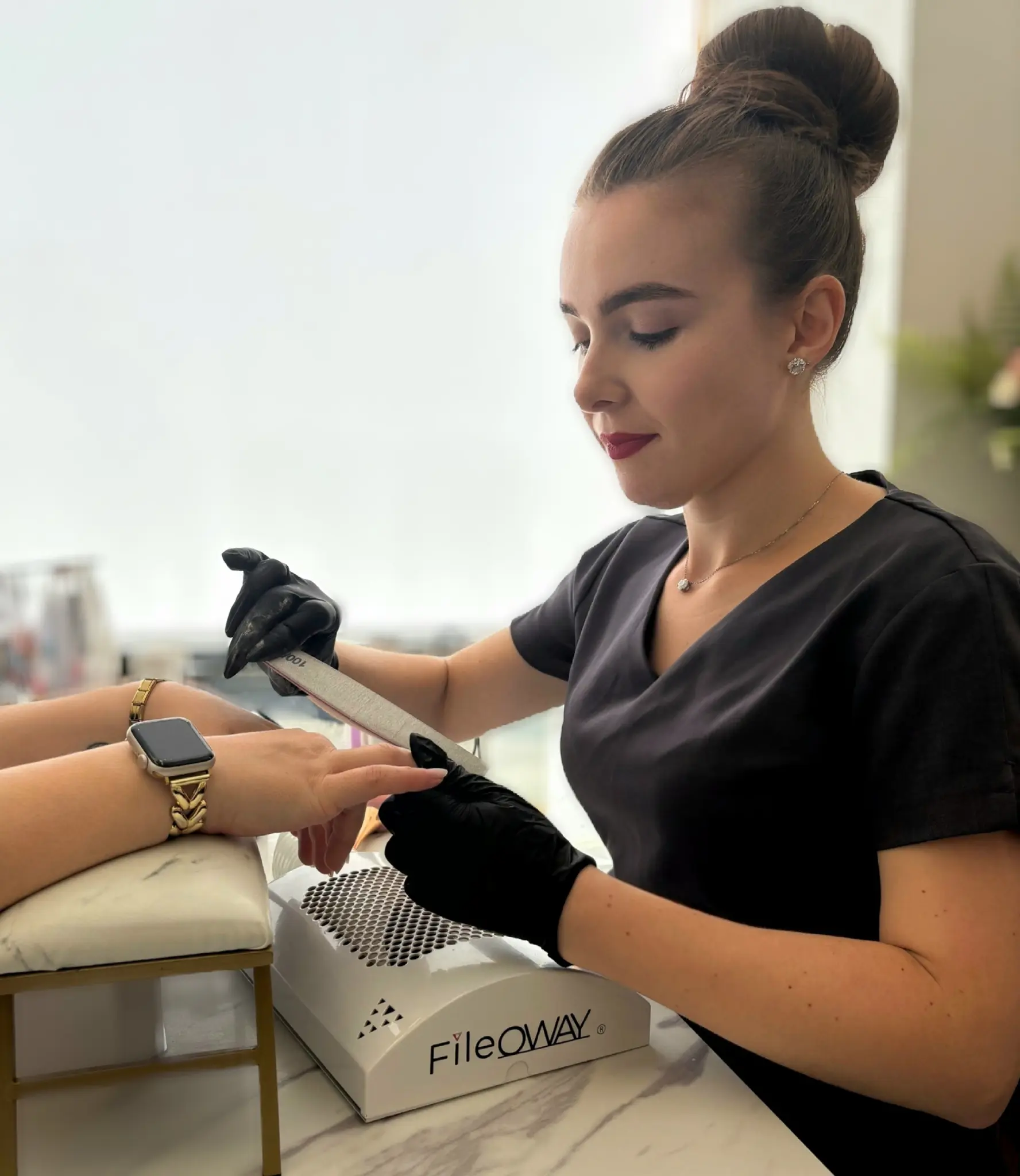
Radina Ignatova is a Professional Nail Expert, Certified Educator, and founder of Artistic Touch – Nail Training Academy, based in Dundee, Scotland, UK.
With hands-on professional salon experience since 2014, Radina specialises in Russian Manicure, BIAB systems, e-file techniques, and comprehensive nail safety protocols. She has worked with thousands of clients across diverse nail types, conditions, and challenges, developing the troubleshooting expertise that cannot be gained from demonstration alone.
Radina holds COSCA counselling accreditation, which she integrates into her teaching methodology to address the psychological barriers that affect skill development: fear of making mistakes, perfectionism, lack of confidence, and anxiety about working with clients. This unique combination of technical expertise and understanding of learning psychology distinguishes Artistic Touch training from conventional nail education.
Her teaching philosophy centres on authentic education: showing real mistakes, explaining exactly why problems occur, and building genuine competence rather than creating impressive demonstrations that students cannot replicate.
About Artistic Touch – Nail Training Academy: Professional online nail education delivered by Radina Ignatova from Dundee, Scotland, UK. Specialising in Russian Manicure, BIAB systems, e-file techniques, and comprehensive nail safety education for aspiring and professional nail technicians. All courses emphasise authentic education showing real mistakes, providing ongoing support, and building genuine professional competence.
Contact us via our contact page for course inquiries and professional training guidance.